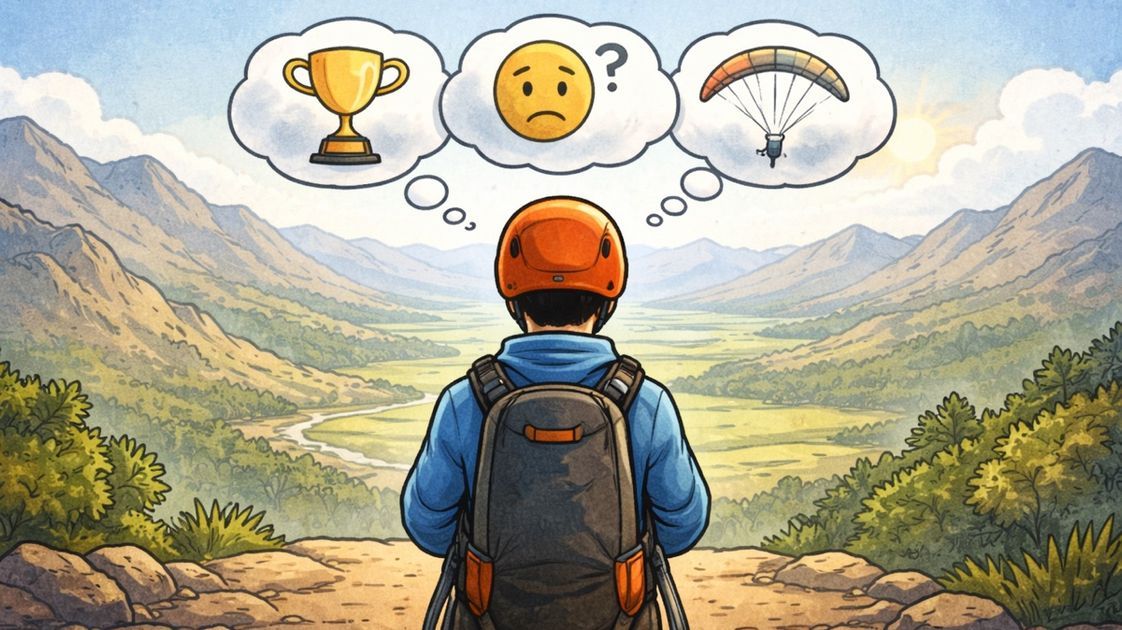
The Risks That Don’t Show Up in the Forecast
December 10, 2025
Why Experience Can Be More Dangerous Than Conditions
Most pilots learn to scan the sky before they learn to scan themselves.
We check the forecast. We look at wind strength, direction, instability, cloud base. We read models, soundings, and site chats. We build a mental picture of the day before we ever unpack a wing.
And that’s good. Necessary, even.
But after a certain point in your flying life, the most significant risks you face aren’t meteorological. They don’t show up on a forecast map or in a sounding diagram. They live somewhere harder to measure — inside the pilot.
Experienced pilots know this, even if they don’t always talk about it openly.
When Conditions Aren’t the Problem
Ask pilots to describe their sketchiest moments, and a pattern emerges.
Often, the conditions weren’t extreme. The forecast wasn’t screaming “don’t fly.” Nothing obvious was “wrong.” What was off was the context.
- Flying tired, distracted, or emotionally flat
- Flying to meet expectations — your own or someone else’s
- Flying because you should, not because you want to
- Flying to confirm an identity you’ve already committed to
These are risks no forecast can warn you about. The sky didn’t change. The pilot did.
Experience: Asset and Liability
Experience is a double-edged tool. On one side, it brings pattern recognition, efficiency, and confidence. You read air better. You make fewer mechanical mistakes. You recover faster from problems.
On the other side, experience quietly reduces friction.
Things that once required conscious effort become automatic. You stop questioning assumptions that used to slow you down. You trust your instincts — sometimes without checking whether they still apply today.
This is how experience becomes dangerous. Not suddenly. Gradually. Risk doesn’t spike. It accumulates.
The Subtle Shift From Evaluation to Justification
There’s a moment every experienced pilot recognizes — usually in hindsight.
You’re not asking “Is this a good idea?” anymore. You’re asking “Can I make this work?” That shift is small, but it’s critical. Evaluation is open-ended. Justification is directional.
Once justification starts, the mind gets creative:
- “I’ll just see how it is.”
- “I can always land early.”
- “I’ve handled worse.”
None of these statements are obviously wrong. That’s what makes them dangerous. They feel reasonable. They feel familiar. They feel earned.
But they’re often signals that the real decision has already been made — and the analysis is catching up afterward.
Goal Gravity
Goals are useful. They give structure to flying. They also distort judgment.
A planned XC route, a personal milestone, a “good day window” — these create goal gravity. The closer you get, the harder it becomes to let go. The problem isn’t having goals. It’s forgetting that goals are optional.
Experienced pilots sometimes get caught here because their goals are internally consistent. They’ve flown this kind of day before. They’ve committed time, energy, and identity to the plan. Backing off now doesn’t feel like a decision. It feels like failure.
That emotional weight doesn’t show up in the forecast — but it changes everything.
Confidence vs. Awareness
Confidence is often treated as the antidote to fear.
In reality, unchecked confidence is one of the most reliable precursors to bad decisions.
Not because confidence is wrong — but because it narrows the range of questions you ask.
Confident pilots are efficient. They move quickly. They commit early.
Aware pilots pause. They notice small inconsistencies:
- a climb that feels sharper than expected
- a drift that doesn’t match the model
- a feeling of rushing instead of choosing
Awareness leaves room for doubt. Confidence tries to close it.
The most experienced pilots don’t aim to feel confident. They aim to stay interruptible.
The Pressure Nobody Talks About
There’s a quiet pressure that builds with experience. People look to you. Newer pilots assume you know what you’re doing. Friends follow your lead — sometimes without saying so.
That pressure is rarely explicit, but it’s real. It becomes harder to say:
- “I’m not feeling it today.”
- “I’m landing early.”
- “I’m sitting this one out.”
Not because anyone would judge you — but because you might.
This is one of the least discussed risks in free flight: identity inertia. You start flying in ways that preserve an image instead of responding to reality. Again, no forecast will warn you about this.
Why Discomfort Is Useful Data
Experienced pilots don’t eliminate discomfort. They learn to interpret it. Not all discomfort is fear. Not all fear is a warning.
But persistent, quiet unease — the kind that doesn’t go away with rational explanations — is rarely random.
It often signals:
- fatigue you haven’t acknowledged
- attention that’s scattered
- commitment that’s outrunning conditions
Ignoring that signal doesn’t make you brave. It makes you blind. The best pilots don’t suppress discomfort. They interrogate it.
A Different Kind of Risk Management
Real risk management for experienced pilots isn’t about adding more rules.
It’s about asking better questions:
- Why am I flying today?
- What am I relying on that could easily change?
- If this stops being fun, will I stop?
- Who am I trying to satisfy with this decision?
These questions feel subjective — and that’s exactly why they matter.
Objective hazards are often manageable.
Subjective ones sneak past defenses.
Reading the Pilot Before Reading the Sky
By the time you’ve been flying long enough, the atmosphere is rarely the only variable that matters.
Your mental state, motivation, fatigue, and expectations shape how you perceive everything else.
Experienced pilots who last learn to read themselves with the same care they read weather models.
They know that the most dangerous days aren’t always the strongest or the wildest.
Sometimes, they’re the days when everything looks fine — except the pilot.
What Comes Next
In the next chapter, we’ll look at the decisions nobody sees: aborted launches, early landings, and the quiet choices experienced pilots make that never show up in stories or tracklogs.
Because most safety doesn’t happen in the air.
It happens in moments no one applauds.