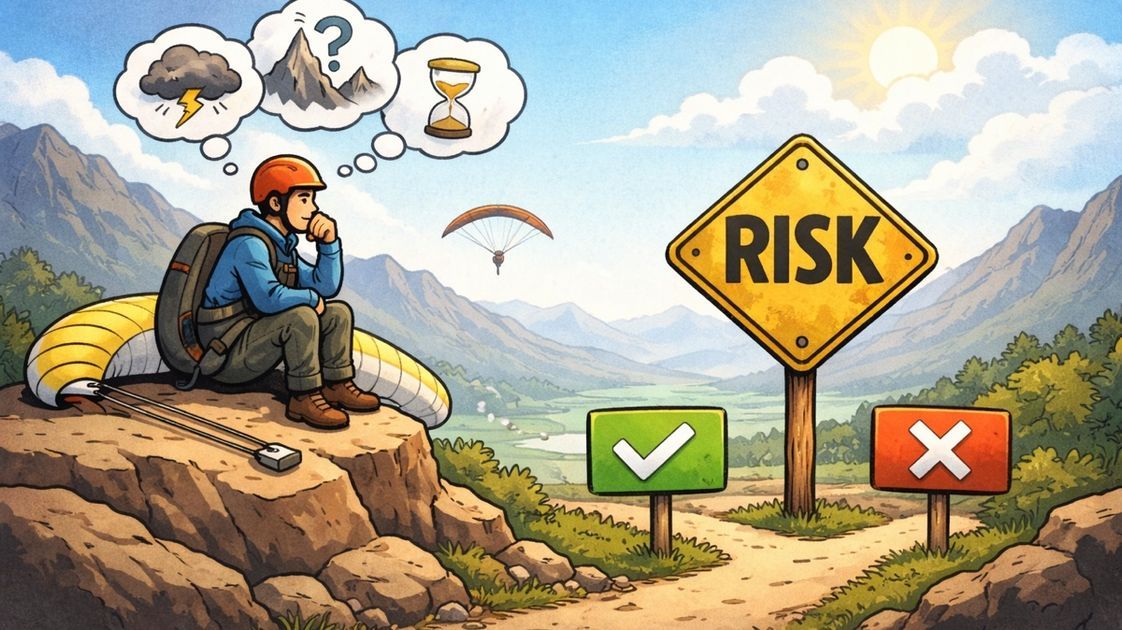
Risk Isn’t the Enemy
December 3, 2025
Why Experienced Pilots Stop Trying to “Be Safe”
There’s a phrase experienced free-flight pilots learn to ignore pretty quickly:
“Be safe.”
Not because safety doesn’t matter, but because the phrase stops being useful once you’ve been flying long enough. In paragliding and hang gliding, risk isn’t a flaw in the system. It is the system.
You don’t manage free flight by trying to eliminate risk. You manage it by understanding it, choosing which risks are acceptable, and carrying enough margin to survive the ones you didn’t anticipate.
That’s the difference between flying for a season — and flying for decades.
Risk Is the Price of Admission
Free flight is not dangerous by accident. It’s dangerous by design.
We fly lightweight wings in a moving atmosphere, launch from terrain that doesn’t forgive hesitation, and depend on energy sources we can’t see. No amount of certification, equipment, or regulation will ever change that.
Trying to make paragliding or hang gliding “safe” in an absolute sense misses the point. You can reduce exposure, improve judgment, and increase margins — but you can’t remove uncertainty.
Experienced pilots don’t fly despite this reality. They fly because of it.
Risk is the price of admission for access to something rare: three-dimensional movement through a natural system that doesn’t care about your plans. That’s not a defect. That’s the attraction.
Why “Safety” Stops Being a Useful Question
Early on, safety is taught through rules:
- stay within limits
- fly the right wing
- follow procedures
- don’t exceed conditions
That structure is necessary when judgment is still forming.
But eventually, every experienced pilot runs into situations where the rulebook goes quiet.
No checklist can tell you:
- whether today’s conditions are right for you
- whether this line makes sense right now
- whether continuing the flight is smart given your mental state, not just the forecast
At that point, asking “Is this safe?” becomes meaningless.
Experienced pilots ask a different question:
“Is this a risk I understand, accept, and have margin for?”
That shift matters. Safety isn’t binary. Risk is contextual.
Risk Isn’t Recklessness
Accepting risk doesn’t mean being casual about it.
There’s a big difference between chosen risk and unexamined risk.
Recklessness usually isn’t dramatic. It shows up quietly:
- when a goal becomes a commitment
- when confidence replaces curiosity
- when backing off feels like failure
- when the plan matters more than the conditions
Most serious accidents don’t happen because pilots wanted danger. They happen because risk was misjudged, minimized, or reframed after the fact.
“I’ve flown in worse.”
“It should calm down later.”
“I didn’t want to be the only one not flying.”
Those aren’t assessments. They’re rationalizations.
Experienced pilots learn to notice when that shift is happening — and to interrupt it.
The Risks That Actually Matter
Ask experienced pilots what worries them most, and you’ll rarely hear “turbulence” or “strong conditions” first.
What concerns them is what happens inside the pilot.
Risk increases when:
- experience outpaces self-awareness
- success creates pressure to repeat or escalate
- identity gets tied to performance
- discomfort gets overridden instead of examined
The most dangerous phrase in free flight isn’t “this looks sketchy.” It’s “I’ve got this.”
Not because confidence is bad — but because unchecked confidence narrows perception. It reduces flexibility. It silences doubt.
Experienced pilots don’t aim to feel fearless.
They aim to stay aware.
Avoiding Risk Doesn’t Make You Safer
There’s an uncomfortable truth many pilots discover with time:
Trying to avoid risk entirely often makes you worse at managing it.
Pilots who never operate near the edge of their comfort zone don’t develop the judgment needed when conditions change unexpectedly. They haven’t seen enough variation. They don’t know how they react under pressure.
That doesn’t mean chasing danger. It means deliberate exposure:
- in familiar terrain
- with altitude to spare
- with clear exit options
- on days when focus is high
Handled this way, risk becomes informative instead of cumulative. It teaches where the real boundaries are — without crossing them blindly.
Risk as Information, Not a Verdict
One of the most useful shifts experienced pilots make is treating risk as data, not a warning label.
Instead of saying:
“This is dangerous.”
They ask:
- What could go wrong here?
- How likely is that outcome today?
- What margin do I have if it does?
- What am I assuming will go right?
Risk stops being emotional and becomes analytical. Uncertainty doesn’t disappear, but it becomes manageable.
You’re no longer hoping things work out. You’re deciding whether the unknowns are acceptable.
Flying for the Long Term
Every experienced pilot knows someone who didn’t make it.
That reality doesn’t demand fear — it demands honesty.
Pilots who last aren’t luckier. They’re better at living with unresolved uncertainty without forcing outcomes. They don’t confuse survival with good decision-making, or success with having margin.
Risk isn’t the enemy. Denial is.
In the next chapter, we’ll look at where risk really comes from — not the sky, but the pilot — and why psychology matters more than conditions once you’ve been flying long enough.